Good Shepherd Lutheran church

Though we welcome you joining the discussion here online, there really is no substitute for being part of the lively discussion in person. Consider joining us at one of our Bible Studies that you can find at Good Shepherd Lutheran Church. Or follow us on facebook.

Friday, February 28, 2014

The case for Christ, part Two

In a sense, it's all about eyewitness testimony.

You see, we have a nasty habit of reading the present into the past.  We have a nasty habit of reading the present into the past, and seeing things that happened thousands of years ago as though the people who were there were just like us.  You and I, we have a bunch of digital cameras around us all the time.  From where I'm sitting in my office, I have 3 in arm's reach (laptop, 3ds, cell phone).  If I want to take a picture of something, I'm seconds away from doing so.  If something essential happens, if there's a big to-do, I can capture it in still or in video, upload it instantly, and get it out there.  As a result, in this world, if I make an elaborate claim, people can bust my chops by essentially saying that old classic 'pics or it didn't happen!'

Yes yes.  There are no pictures in the Bible, no cameras, no magic, none of that, and so we approach the presence of Christ with a large dose of skepticism.  We look at the word of the Bible, and say to ourselves 'well, this was all written by largely illiterate fishermen and tentmakers, so how reliable can it possibly be?'  Without corroborating media, and given the distance between the events and their recording, how reliable can they possibly be?

This is where our understanding of oral traditions has to kick itself into high gear.  And this is helpful for us as Canadians, becasue we have a built-in knowledge of oral traditions, or at least we should.  In an age of quick video, and instant messaging, in an age in which we have access to media as soon as it has happened, this country and this society has had a real, legitimate issue with oral history and tradition before.

You see, our great nation has had a great many and various number of first nations groups who have laid claim to land, who have brought forward suit, and who have not had anything like what we would consider to be 'evidence' to back it up.  So, no evidence, no case, right?  Welllllllllll, not exactly.  As of late, the people who have only an oral history have actually had said evidence heard in court as admissible in court.  That is, the good people of our first nations, who told stories, danced dances, sang songs, and didn't have what we would call a written history, can have their oral histories and traditions heard as admissible in a court of law in this great nation.

What does this mean for us?  It means that perhaps oral tradition is more important than we thought it may have been to begin with. It means that we can get a lot done with our oral tradition that can stand up to rigorous scrutiny, provided that it is a matter of public record well known by the people who use it.  And this is the thing.  The case cited involves stories, songs, and dances that had been used for thousands of years.  The gap in the Biblical record, from when stuff happened to when it was written down, was about twenty years, at the smallest.

You and I , as I say, we have a deep desire to read the present into the past, to see  people, texts, events, as though it was us looking at it, and saying to ourselves, 'gosh, I sure wouldn't trust this at all.'  But we can't, and we ought not.  Or to put it another way, we know that Jesus is the most important guy who has ever lived ever, but of those living at the time, only the Christians worked out that he was.  Nobody else paid much attention to this itinerant street preacher, save those who were internalizing his message.  And with that being the case, Jesus remains shockingly well known amongst those who were in the world at the time.  If you compare him with others who were around at the time, comprable  people who had their names known through oral tradition and history, you'd find that very few of those still remain.  With Jesus, there are more copies, earlier manuscripts, and a greater depth of knowledge than the overwhelmingly vast majority of othe people who lived at the time.

It's really interesting, actually, once you start getting into it.  And when you do get into it, the entire history of the scriptures opens up and blossoms in front of you.  You see the copies and evidence of sources.  You see the way in which the scriptures were written down for you, and you see the fingerprints of the eyewitnesses all over their stories.  In other words, the deeper into this you get, the more interesting it becomes, and the less you can dismiss it by just saying 'oh, well, that's unreliable.'

Tuesday, January 28, 2014

The Case for Christ - Part One

Okay, here's a link to the video, since I can't seem to imbed it here.  How frustrating.  I will keep working on it.


We'll be looking at this video on Thursday, but before we do that, here are some questions to ask, or to mull over as you watch the video.

The big question, and the one that hangs over any conversation about the Scriptures, and about Jesus, is really, how do we know anything?  Although this seems like a simple question on the surface, it's actually much harder than it appears.  The thing is, our entire lives are spent standing on the shoulders of giants.  If you listen to the woman who says, early on in the video "I don't believe in God, first of all, because I grew up in an age of science," that sort of says it all.  The thing about the scientific method is that it is a force to be reckoned with, surely.  But it depends on repetition, on observation, and that's much more difficult to do with an event that happened once and once only.  This is what happens with history, in that history and science don't occupy the same camp.

Another guy who speaks at the beginning (0:15) asks of Jesus to show up at his work with the Stigmata, then he'd believe it.  Counter that with the man who says about ten seconds later that he doesn't believe that coming back from the dead is really possible.  How are those two statements held in tension with the story of Lazarus and Dives from Luke's gospel?

When Lee Strobel says, at 2:00, if Jesus existed, which he's not sure about, he was a great teacher and a nice guy, but certainly wasn't the Messiah, and certainly wasn't the Son of God.  The nature of this statement is worth considering as people who are working through the Scriptures, since we will encounter people quite frequently who will approach the story of Jesus with a lack of certainty about even his existence, but with 100% certainty about his lack of divinity.  Contrast this with the attitude of the man from Mark 9:23-25. This is a man who was certain about the existence of Jesus, yet who realized that he needed help in his faith.

At about 3:20, when Lee takes the course from Hybels, he mentions that he was going into the church with a lot of misconceptions about the Christian faith, what it is, and what it does.  Given that he wasn't familiar with the Bible at all, where was he getting these misconceptions from?

At 4:45, when the man talks about the distance between the events and their recording, compare that with the distance between when Hannibal was crossing the alps on elephants, and when historians wrote the details of his conquests down.  Hannibal lived from 247-183 BC.  The historians who wrote his life down lived between the following years:

Polybius (200-118BC)
Livy (59BC - AD17)
Appian (AD95-AD165).


Of the three, only one (Polybius) was even alive for the life of Hannibal, yet these details are considered to be essentially correct in their makeup.  I know this is going to come up in the book / video series again, but it's worth knowing that the Gospels were not unusual in what they had to say and do.  The distance between the life of Christ and the writing of the Gospels is not strange, nor should it be considered to be a mark against the Gospels that their writings came out not so much the next day, but within a human lifetime.


Okay, that's a good start.  Enjoy your refresher on this stuff, and we'll talk more about it on Thursday.  

Friday, October 4, 2013

The middle class


Tonight, we spoke at semi-great length about the middle class, and about middle class Christianity.  The main issue for us was, and is, that we tend, above anything else, to make God in our own image.  That is, we tend to have a God who fits us, rather than seeing his words as required for us to fit.  Now, this is an enormous problem for pretty much everyone ever, prince to pauper, and Jesus is just malleable enough for us to make him fit us all.  Take, for example the following people


There is essentially no shortage of this, and this is essentially the default Christian perspective too.  I hate to be this guy, but it is.  What we have gone to great lengths to do is to have Jesus agree with us by whatever means necessary.  He is seen by us as someone who will by definition almost always agree with us and where we are.  But then who is Jesus anyway?

This is the last and greatest form of idolatry that exists in the world today, in that it takes God and empties him until he resembles an idol.  Do you find it strange that Jesus Christ would be seen by Mahmoud Ahmedinejad, Richard Dawkins, Adolf Hitler and you as agreeing with them?  Can he agree with all of you at the same time?

No.  No he can't.  He obviously can't.  He can't hold those four positions in tension, agreeing with the man who sought genocide, the man who seeks genocide, the atheist who doesn't think he exists as God, and you.  Impossible.  But what people have confused, where they have gone off track, is where they assume that Jesus' unconditional love also equals unconditional agreement.  And only one of those things is true.

Jesus, God, the Holy Spirit, they love everyone.  They absolutely do.  They have a love for all their children, not based on what they do, but based on their love for their children. If you have children of your own, or have been a child, then you'll know that it is perfectly possible for you to have parents who love you, though they disagree with the many and various decisions you've made.  It doesn't mean they don't love you, but it does mean that they may find their love for you wrestling with their disagreements with what you do.  This is key for understanding who Jesus is and what he does.  

Think of the rich young ruler.  When he approaches Jesus and asks 'Good Teacher, what must I do to inherit eternal life?' he does so intending to be justified by Jesus before any actual tips.  Although Jesus is going to have some pretty tough stuff to say to him, the account of the encounter in Mark's gospel has an interesting detail.

'Teacher,' he declared, 'all these I have kept since I was a boy.'
Jesus looked at him, and loved him.

Jesus looks at him and loves him. He then commands him to go and sell all he has, and give it to the poor.  Do you see what's happening here?  It's not that Jesus doesn't love this guy (he clearly does, and
the Bible says he does), but his love does not equal agreement with the man in question.  The guy doesn't get a pass on his actions just because Jesus loves him.  Jesus loves him and then commands him to feed the poor.  Jesus loves him, and then tells him that nothing that he ever does is enough to earn his salvation.

And this is where we in the middle class are as relates to Jesus Christ.  We tend to get very smug, and we tend to inquire of Jesus what we must do to inherit eternal life, expecting him to say only what we're already doing.  And Jesus looks at us, and loves us.  And then he tells us that he has given us blessings to be a blessing to others.  He hits us where it hurts, and for us, it's usually in our comfort.  For Ahmedinejad, it would be in the turning of the other cheek, for Dawkins, it would be in the humility and the faithlesness, and for us, it would be in the comfortable middle-classness.  He is many and varied, that Jesus Christ, and he can and does hit us where it hurts.  He is ever loving, ever forgiving, ever present and ever full of passion for his people.  

But he is not ever condoning.  If you read through the Bible, and can only see where Jesus agrees with you, then read it again.  He looks at you and loves you, but he wants to forgive you of all your nonsense, of which there is plenty.  Recognizing that is key to understanding the work that Jesus does, to forgive not only the stuff you do, but to deal with all the stuff you don't do. To deal with the fact that you are not in line with what he says about the kingdom of God.  

And now you know.  And knowing is half the battle.  And the other half is grace.  

PJ.

Saturday, April 27, 2013

Worship


My big question is; what is worship? For some it is a specific time, a specific place and following a specific pattern. For others, it is the entirety of life, everything that a person does can be considered worship. As we were discussing it, the general consensus was that anything which glorifies God is worship.

If we have such a simplistic idea of what worship is, then why does worship become such a hot-button topic?

Within Christianity, Protestantism, Lutheranism, LC-C Lutheranism, heck even within Good Shepherd Lutheran Church, there is a great divide over what worship should look like. Our biggest concern is about what we want, not necessarily a concern for why we do what we do.

What if we did make the why our starting point? What would be the answer to the question “Why do we worship God?”

My favourite answer to that question was “Because he said so.” Mostly because that is so often our default answer to any why question is because I/he/she/you said so! We accept whatever it is without argument and it becomes canon law.

In this case we can dig a little deeper and look at what God actually says about worship.

Specifically I would like to look at what he commands us concerning worship.

It goes beyond just you shall not worship any other gods, which I know is the commandment you thought of first, because it’s also the commandment that I thought of first too! But we can see how all of the first three commandments really deal with how we worship God. Beyond just not worshiping other gods, we’re reminded that in the first commandment we are called to fear, love and trust Him. Worshiping God includes all of these elements, not just avoiding other gods. It includes the way we treat Him in our everyday lives, the way we keep from using His name in an inappropriate manner and instead we “call upon it in every trouble, pray, praise and give thanks.” We worship God through the respect we have for the Sabbath day; the fact that we want to take the opportunity gladly hear and learn from God’s word.

These three commandments really do make up the core of what worship is. When God commanded us to do these things, he did so knowing that it was in our best interest to worship Him, and Him only. These commandments point us towards a knowledge of his greatness and our weakness; they remind us of the power held in his name. When we gather together in worship, often we do so without remembering God at all. We do the same thing we’ve done every Sunday, sit in the same spot, speak the same words, make the same confession, but we do without remembering why we were commanded to do so. We don’t think of the fact that we desire to hear His teachings, that we have the opportunity to give thanks and praise Him, but we worship out of obligation, because He said so.

One of my favourite worship songs is by Matt Redman, and it’s called “The Heart of Worship.” I like it because it speaks to me about this very same issue. It reminds us that at the core of our worship, we need to ensure that everything is about Christ. This goes beyond us confessing faith in Jesus and instead involves us actually believing that and putting it into play. When we worship, we need to take ourselves out of our comfort zone and worship God without concern over what we’re getting. We will be receiving infinitely more than we could ever possibly bring, but we aren’t there to worship ourselves. We are there to be humbled and to be reminded of the sacrifice that Christ made in order to provide us with all that we have, all that we are, and all that we will ever receive. When we worship, we worship God, knowing that it's not about us anymore, it's about what we've been through Christ.


Saturday, April 13, 2013

Vines, vines everywhere are vines


I’ve made the confession before and I will likely make it several more times throughout the course of my life…I am a failure at plant care. To say I have a black thumb is putting it lightly. If a plant lasts a month in my care it is akin to a miracle.

As useless as I am with plants, they continually amaze me. What amazes me the most is how they manage to subside using what we as humans consider to be absolute rubbish…quite literally I might add! A plant lives in the dirt; something that we avoid like the plague, lest we end up with a speck upon ourselves. Beyond that, a plant is happiest when covered in poo and the decomposed remains of our supper last night. In essence, a plant uses what we avoid.

But then, the plant produces amazing things that we want desperately. As I’m typing this out, I’m looking at a lovely bouquet of flowers that was the result of a plant growing in our waste. The food that we eat is produced from the leftovers that we couldn’t use. A plant comes from humble beginnings but becomes quite important.

In particular, as you’ve likely guessed by the title, I want to point out the vine. It plays a very important role as it helps to produce one of the most delicious beverages known to man (and woman!) kind.

The vine also plays a large role in several biblical accounts. In the Old Testament the vine is used to describe God’s own chosen people.

In Genesis we see that Joseph is described as a good and fruitful vine. The faithful nature with which Joseph served God provided the roots for a continually growing vine. We see the vine growing throughout the Old Testament as more and more people are added in, as the lineage develops further, until, just like the plant, the vine of Israel is widespread and what started out as the beginning of a living bough had developed into a large, powerful vine.

As we know from the various stories of the Old testament, this vine wasn’t necessarily as effective as it could have been. Jeremiah points out the way in which this vine that had been planted from the hardiest of seeds, that God’s chosen people, whose good and perfect beginning was described in the book of Genesis, very quickly morphed into the wild and degenerate vine that was being threatened. God’s people no longer represented the perfection in which they had been created, but they had grown their way, did not produce good fruit and were no longer the good vine that God had intended them to be.

This is the situation that we’re faced with when we look at the account of the True Vine as described in John 15. Going back to what we know about the analogy of the vine, we are aware that the vine is representative of God’s chosen people. Much like we would describe a family tree, the lineage of the Israelites is portrayed by the imagery of the vine. We are aware that the vine was corrupt and wild, not producing good fruit. In John 15 we see a comparison between the corrupt vine, and the true vine, that is the vine that is Jesus Christ.

In this passage we are reminded of our need to be connected to the true vine. As we look back on the bible many years later we can see how the Israelites failed. We know that when they were left on their own they turned wild and corrupt. They were unable to maintain the perfection for which they had been created. Lest we think that we are any better than they were, this verse reminds us of our need to be connected to the true vine, in order that we would also be able to produce good fruit. Like the Israelites, when left untended we are wont to turn corrupt and wild as well. We depend on Christ to provide us with the goodness we need, we depend on God the father to remove the sin and all bad things from us in order to allow us to grow. We are dependent upon God to provide for our needs, to feed us and to keep us healthy.

As we read through this passage in particular, it’s very clear about the role that God plays in our
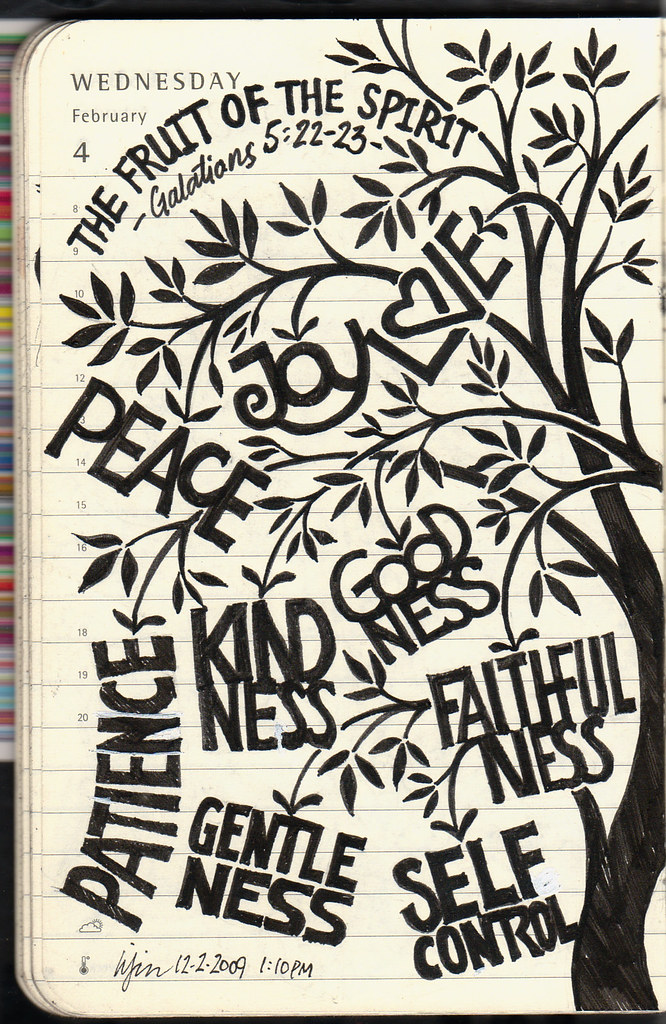
development, care and maintenance but what remains a little more vague is what this idea of bearing fruit looks like for us. It goes beyond producing something to eat, obviously, and it isn’t even constrained to bearing fruit in terms of growing the church and increasing the population of believers. When we’re talking about the fruit being produced and how it proves us as Christ’s disciples, it’s helpful to look at Galatians 5:22-23.

It spells out quite clearly that these are the fruits of the spirit. Through the spirit’s work in us, as Christians connected to the true vine and tended to by God the good gardener we desire to produce these fruits that are encouraged by the work of the Holy Spirit. As a result of being fed by Christ and tended to by God we are able to produce these fruits that have been laid out in this passage. This is the work for which we were created; the reason we have not been tossed in the fire.

We are not able to create this fruit on our own. We depend on the work of God to turn the rubbish that we’ve been given in life into the fruit that we are called to produce. Just the same as the plant uses the most unusual, and often least desirable items to produce good fruit, God uses us, and the rubbish of our lives to produce good fruit, whose benefits can be seen in what we do, in who we are, and most importantly, in what we believe.

Wednesday, April 3, 2013

Unity


We’re not talking about small town Saskatchewan.

We’re not talking about peace.

We’re not talking about marriage.

More than anything we’re talking about differences.

Anytime somebody brings up unity it tends to evoke feelings about one of the first three, but very rarely is it associated with differences, unless of course, we’re talking about how to get rid of any differences that we might have.

Throughout the scriptures we see unity being described as the way that we celebrate and utilize our differences. Not that we ignore them and pretend that we’re all the same, but rather that we acknowledge our differences and use them in a beneficial manner.


One of the best examples of this is found in Ephesians 4:1-16

In the beginning of this passage we see unity described in a manner to which we are accustomed: one body; one spirit; one Lord; one faith; one baptism; one God. And that is definitely the root of our understanding of unity. We believe that we all put our faith in the same God who is Lord over all. We confess weekly that we are all connected through one baptism; the baptism that was instituted by Christ and brought to each of us by the Holy Spirit. But what makes unity so unique is what happens next.

Verses 11 and following outline all the ways that we are different. All of the different gifts are laid out and it is pointed out that it is only through the presence of these differences that we can truly see unity.

This idea isn’t limited to just this one passage of scripture, however. Probably the best known example of this is found in 1 Corinthians 12:12-31 where we hear the discussion about the body of Christ. We’re made aware that the body doesn’t function when all the parts desire to fulfill the same role.

Just the same, the church doesn’t work when all the members desire to fill the same role.
When we all sit back and want to be served, we see a church that is stagnant and full of complaints, but no solutions.

When we desire to all be a part of evangelism and neglect the necessity of education, we see a church that balloons in size, but then dies because there is no room for growth.

We are all given different things that we are good at. As veggie tales famously points out, “God made you special.” You were created in a way that no one else was. If you were created in a way that is different than everyone else, why would you assume that you were supposed to be doing the same thing as everyone else?

I’m always amazed at people who can use their talents in such amazing ways to serve God. Looking through our music cabinet at the church, there are so many songs that are written by the people in our congregation, and they are dang good songs. There are wooden fixtures throughout the church that express our faith through the intricacies of the church member who created them. There are annual occasions which we enjoy the fruits…err…meats of the hunting endeavors of other members too.

This is unity; the realization that we are all a part of one faith, one baptism, one church, but that we were not all created the same. Through our differences, and as a result of the desire to use these differences to build one another up, we have unity. Not that we are all the same, not because we have skills and abilities that can only be used outside the church but the fact that who we are, what we do is tied to the church and to all those around us. Our unity is not just that hour on Sunday, but it is our whole life, everything that we do, and everything that Christ has done through us.

Thursday, March 21, 2013

Temptation-more than just a cat's treat


Sometimes, I’ll admit it, these bible studies are written for my own benefit.

If you’re a damnable sinner like me, you’ll be able to admit that you struggle with temptation.

A lot.

You’ll also admit to a feeling of disgust when you think about everything that tempts you in a day.

But, why?

Here’s a secret for you…


Temptation isn’t bad.

Being tempted isn’t a sin, it’s a reminder that there’s sin in the world.

When temptation hits, it’s our reminder of mortality, and of our need to evaluate what is really important in our lives.

When I was in school, I hated tests. Not because I wasn’t smart, I was (notice the word was!) but it was because I hated memorization. Wasn’t good at it, and I’m still not!

But tests in school were tolerable because you could prepare for them. You could take the time to study and review all the information that you were supposed to know and go from there.

The tests that we face in life aren’t nearly so simple.

There’s no prep time, and usually you’re forced to make a decision in a split second. These tests are a lot harder and the results mean a heck of a lot more.

These tests are found all over the place, let’s check out John 6:1-7 for one such example.

What I really want to draw your attention to is verses 5- 6:

Lifting up his eyes, then, and seeing that a large crowd was coming toward him, Jesus said to Philip, “Where are we to buy bread, so that these people may eat?” He said this to test him, for he himself knew what he would do.John 6:5-6
Jesus takes this opportunity to test Philip, to make him think about what he trusted; the ways of the world or the ways of God?

We’re constantly being tempted by this same predicament and left to question whether we put out hope in the promises of mankind, or in the promises of Christ.

James 1:2-4 expounds further upon this idea of testing.

How weird is it to think of being tested as a blessing? To consider that the temptations we are currently living through could possibly benefit us in some manner?

But think about your decision making process. You have that choice to make, you put a lot of time and energy into the decision and it ends up blowing up in your face. What happens next? You either forget everything that happened, or, more likely, you remember and learn from your mistakes. This is the same thing that temptation does for our faith. When we’re tempted, we can make a decision to do what we know is right, or what we know is wrong. In either situation we are learning. Even in those times that we feel terrible about the decision that we’ve made, we are being strengthened and reminded of what our faith actually looks like, where it is wanting, and what we need to do.

When we look further into this chapter, it becomes more and more evident how much temptation can grow when left untended. Earlier we discussed how it can make you grow when realized and built upon, but unfortunately the opposite holds true as well.

Blessed is the man who remains steadfast under trial, for when he has stood the test he will receive the crown of life, which God has promised to those who love him. Let no one say when he is tempted, “I am being tempted by God,” for God cannot be tempted with evil, and he himself tempts no one.  But each person is tempted when he is lured and enticed by his own desire.  Then desire when it has conceived gives birth to sin, and sin when it is fully grown brings forth death.James 1:12-15
It’s very easy for temptation to grow into full blown sin. It’s very easy for said temptation to take over one’s life. This sin can grow and grow until it’s all encompassing and it becomes all that you can think about. You’ve gone past the point of even caring if what you’re doing is right or wrong.

The worst part is, there’s nothing you can do about it.

We all fall prey to the siren’s call of temptation. We all neglect what we know is right and move to doing what is more fun and produces the more favourable, immediate result.

 So, what do we do?

Rather, what should we do?

Be sober-minded; be watchful. Your adversary the devil prowls around like a roaring lion, seeking someone to devour.  Resist him, firm in your faith, knowing that the same kinds of suffering are being experienced by your brotherhood throughout the world.  And after you have suffered a little while, the God of all grace, who has called you to his eternal glory in Christ, will himself restore, confirm, strengthen, and establish you.1 Peter 5:8-10

You heed the words of Christ. You depend fully on the actions that have made you a redeemed child in God’s sight. Will there be times of temptation? Of course there will! Will you succumb to those temptations? More likely than not, yes! Will you be forgiven? Yes!

Christ has promised that he will be there to strengthen you. Jesus gave his life on the cross, in order that yours and mine would be saved. He did this all the while realizing that there was no way we could resist all these temptations on our own, but also while giving us an example which we could follow whenever we were tempted.